
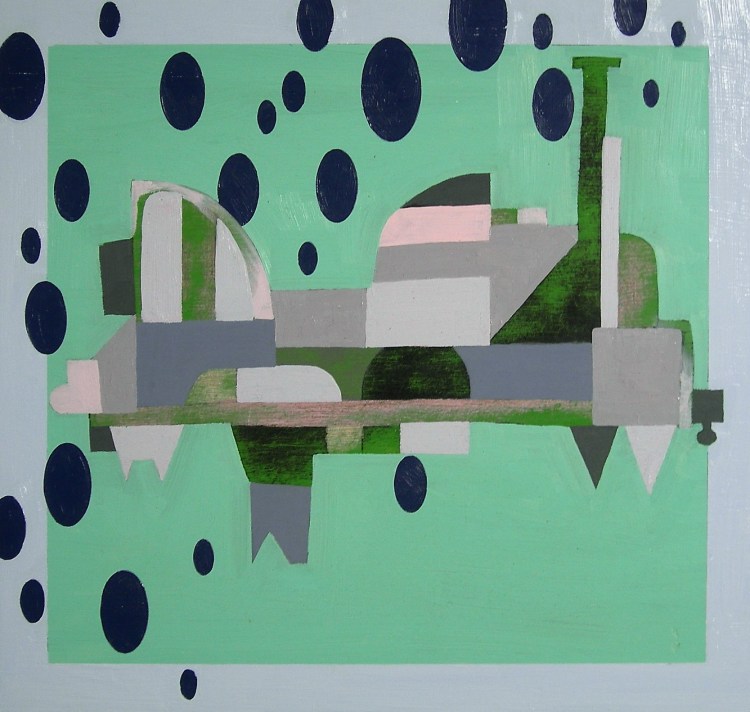
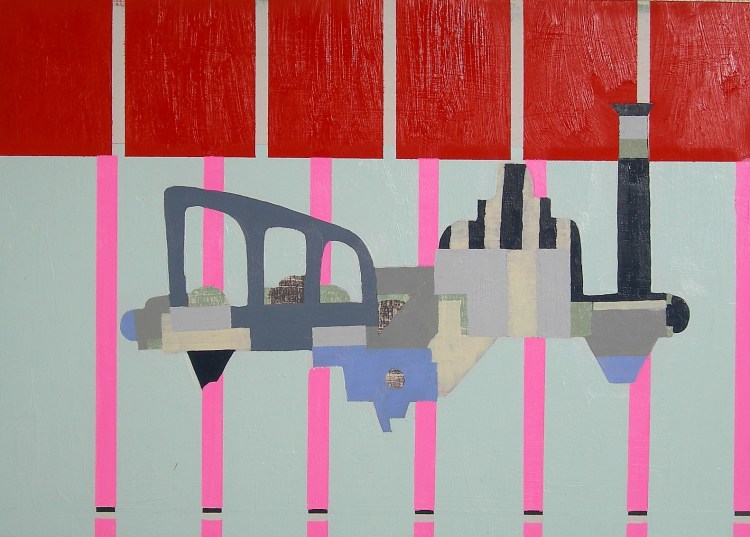
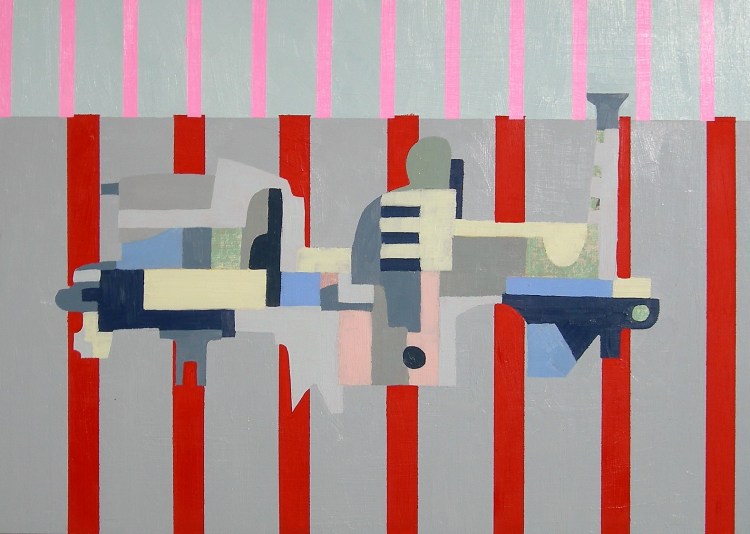
Boom, Boom, Treasure Hunters (2006) is a progressive series of oil paintings, created on retrieved and repurposed board, that evolved during a formative period living in Tokyo—a city where the visual density and relentless layering of form seemed both overwhelming and oddly familiar. The works emerged through a process of quiet observation and accumulation, as I began documenting the strange and persistent shapes that populate the city’s subconscious visual field. These are not the grand architectural landmarks or carefully designed icons of urban identity, but the accidental forms—the overlooked, the oddly shaped, the marginal objects that quietly define the texture of place.
Each painting reveals a surface worked over time: layered, scored, painted, and repainted. A rhythm of repetitive mark-making accumulates, not to fill the space, but to veil, obscure, and occasionally expose traces of removal. Ghosts of objects—now absent—hover beneath the surface, their outlines barely visible, like impressions left in dust. In this way, the paintings enact a kind of excavation. The process mirrors the experience of city living, where memory, movement, and image collide and overwrite one another in an endless visual palimpsest.
Against these textured surfaces, peculiar objects appear to float—disconnected from gravity, time, and purpose—yet intimately linked to the detritus of the everyday. Abandoned umbrellas, sunken boats, orphaned vehicles, rusted smokestacks, and fragments of war memorials drift across patterned fields. These are not literal depictions, but symbolic accumulations—things once useful, now displaced, suspended in uncertain relation to one another.
The patterned configurations that form the background serve both as grounding and camouflage, offering a sense of order while echoing the formal repetition found in the city itself—grids, tiles, screens, signage, and the endless units of urban infrastructure. The tension between form and field, between object and absence, generates a visual rhythm that moves between memory and forgetting, presence and disappearance.
Boom, Boom, Treasure Hunters (2006) can be understood as quiet keepers of memory. They do not shout or explain, but instead offer themselves as the outcome of a searching—an intuitive hunt for fragments, remnants, and visual relics from the wreckage of daily life. Through collecting, composing, and reframing, these paintings propose a new kind of whole: not one that resolves or restores, but one that accepts fragmentation as a fundamental mode of understanding.
Here, painting becomes a form of salvage—an archaeology of the overlooked. The “treasure” is not precious in the traditional sense, but charged with significance: objects once lost, now given space to float, connect, and resonate.



 morgan veness