
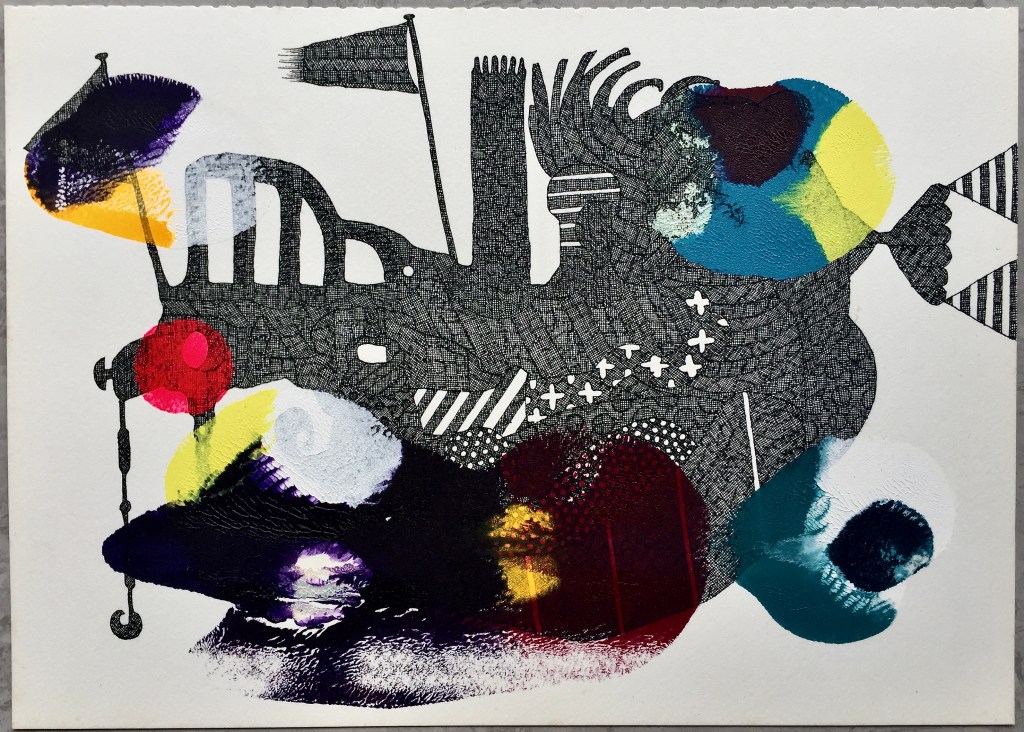
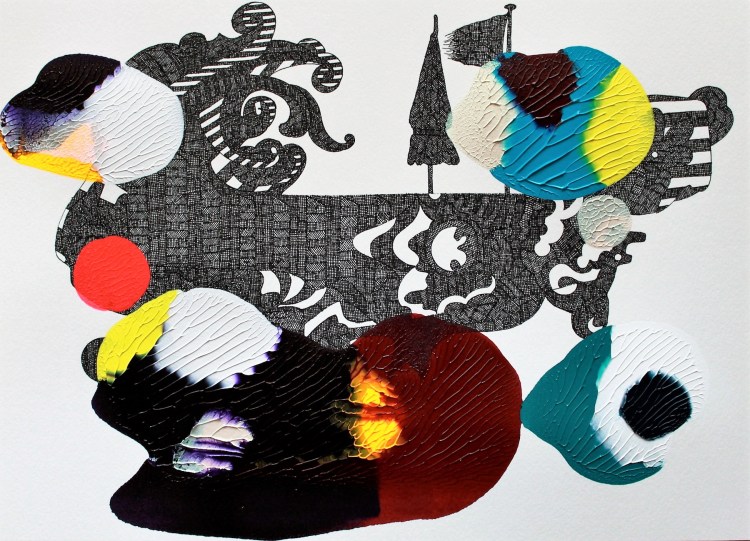
Boom, Boom, Treasure Hunters (2010) is a series of works—rendered in acrylic paint and black ink on paper—developed as a meditative response to the dense, often overwhelming visual landscape of Tokyo, where I was living at the time. Conceived as a progressive series, Boom, Boom, Treasure Hunters (2010) emerged from a process of attentive observation and intuitive accumulation, as I began to document the curious, often unconscious visual language that defines the urban fabric of the Japanese metropolis.
The compositions draw from the strange abundance of peripheral forms—the awkward, the outmoded, the misplaced—that silently populate the city. These objects are not central to the official image of Tokyo; rather, they inhabit the margins: discarded umbrellas, sunken boats, orphaned vehicles, factory smokestacks, fragmented war memorials. Suspended across the surface of each work, they drift in uncertain relation to one another, floating amid—or sometimes behind—a layered arrangement of patterned configurations. These backgrounds evoke repetition and rhythm, suggesting both the formal structures of the city and the underlying systems that organize (or attempt to organize) visual chaos.
The act of painting here is one of collection and reassembly. Forms are gathered like fragments from a shipwreck—salvaged from the wreckage of use and memory—and recomposed into a new visual constellation. The patterning, both decorative and symbolic, offers a scaffold within which these objects can be held, though never fully explained. Their relationships remain provisional, associative, like clues in a dream or the remnants of a half-remembered story.
The title Boom, Boom, Treasure Hunters carries with it a sense of urgency and play—a rhythmic pulse that mirrors the act of searching, sifting, and reimagining. The “treasure” in this case is not material wealth, but the poetic residue of everyday life: things lost, broken, or cast aside, now rendered visible and recharged with meaning. These works do not seek to restore wholeness in a nostalgic sense, but rather to propose a new kind of coherence—one that embraces fragmentation, displacement, and the layered complexity of urban memory.
As such, Boom, Boom, Treasure Hunters (2010) serve as quiet keepers of the overlooked. They are the outcome of a search: not for answers, but for presence—for those silent forms that speak to us from the edge of vision, offering themselves not as final conclusions, but as developing insights.




 morgan veness