
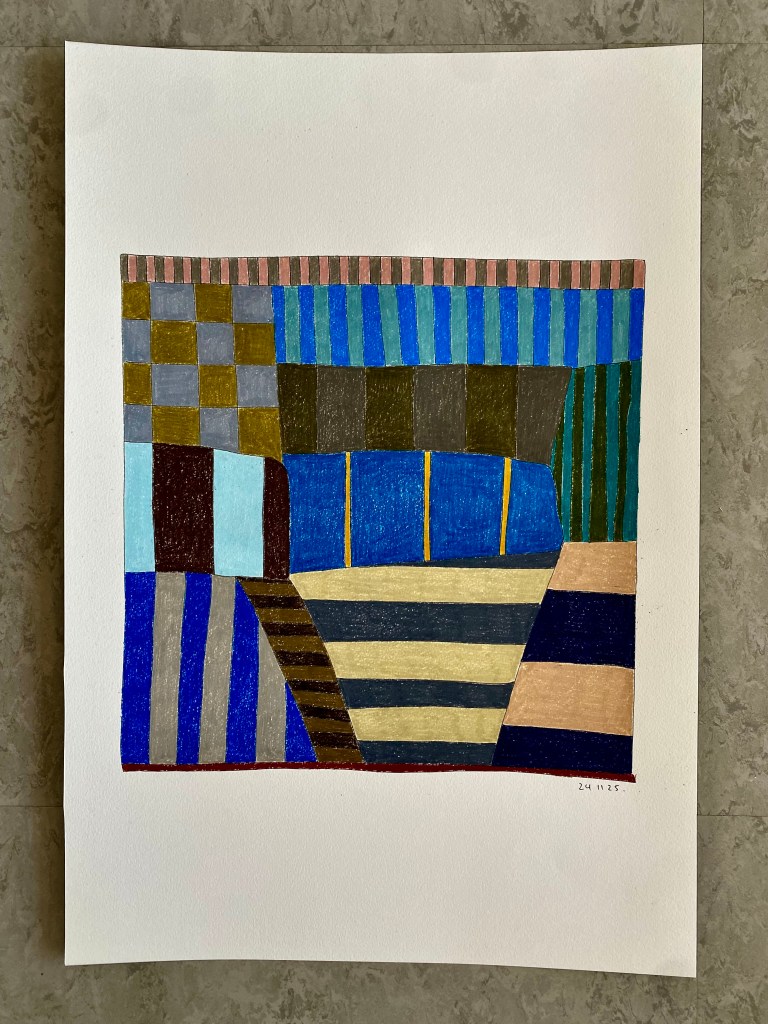
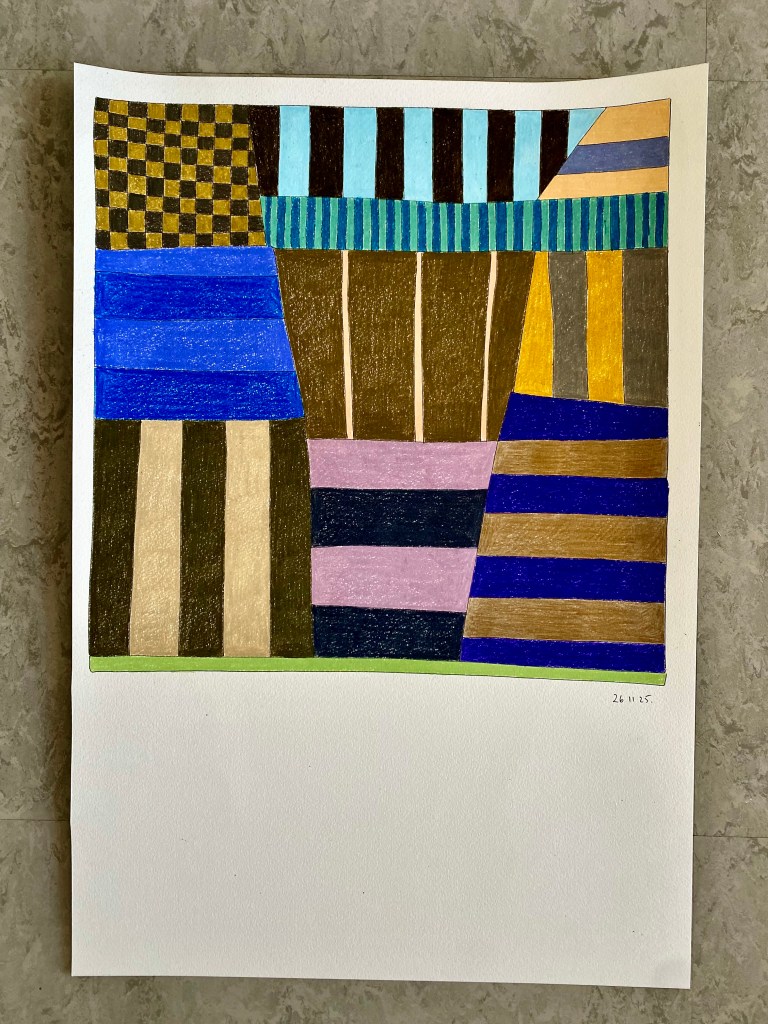
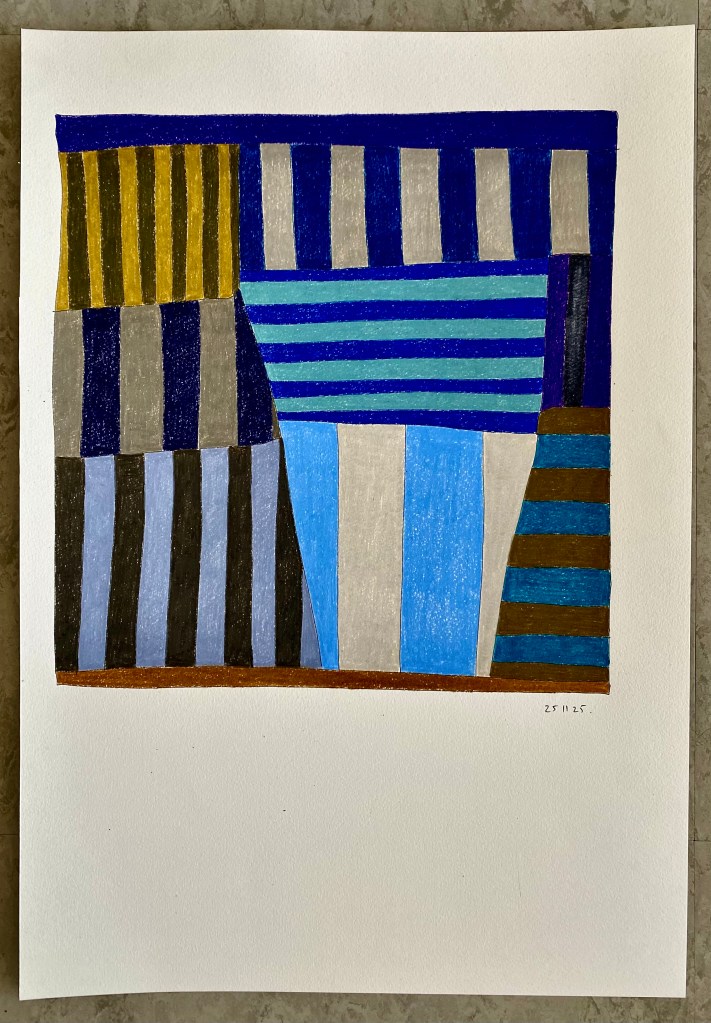
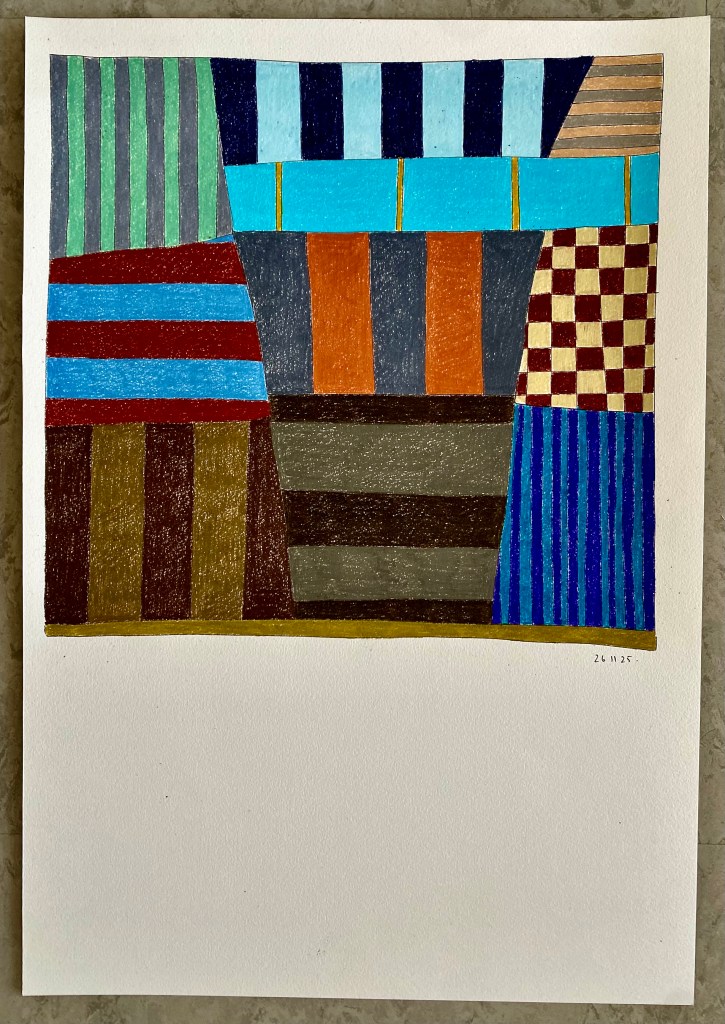
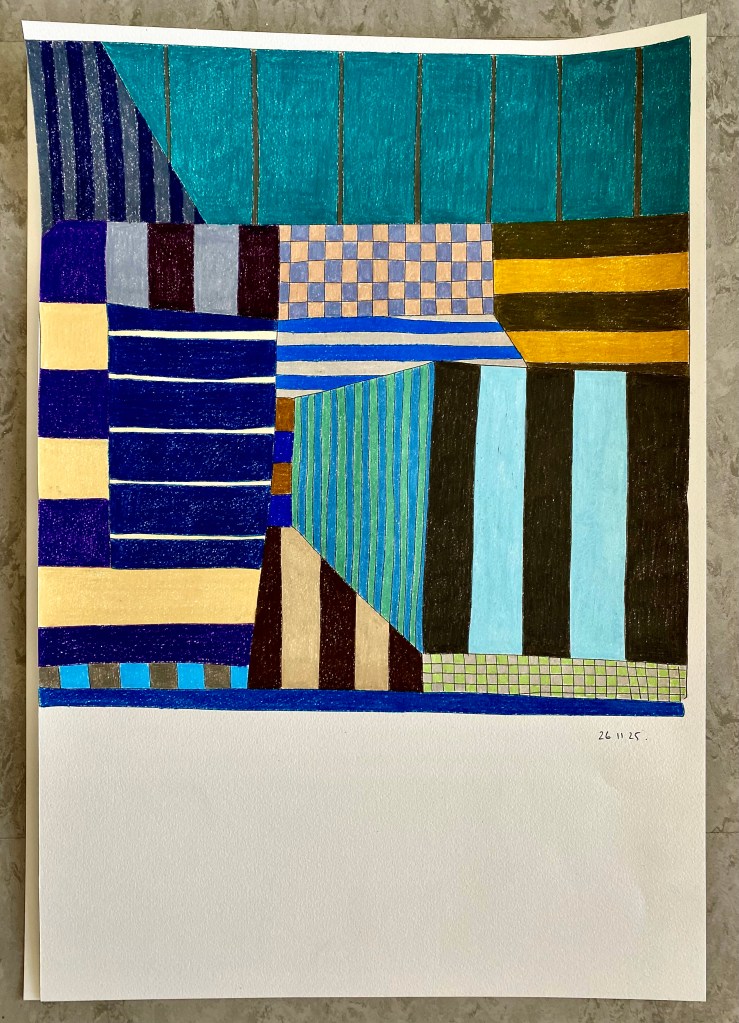
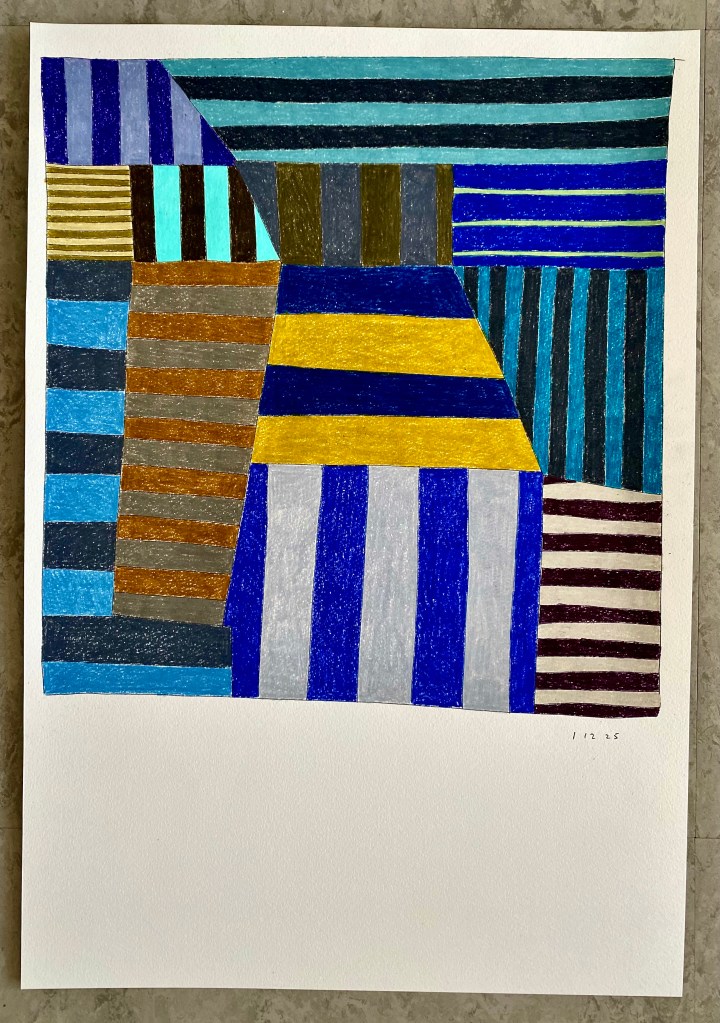
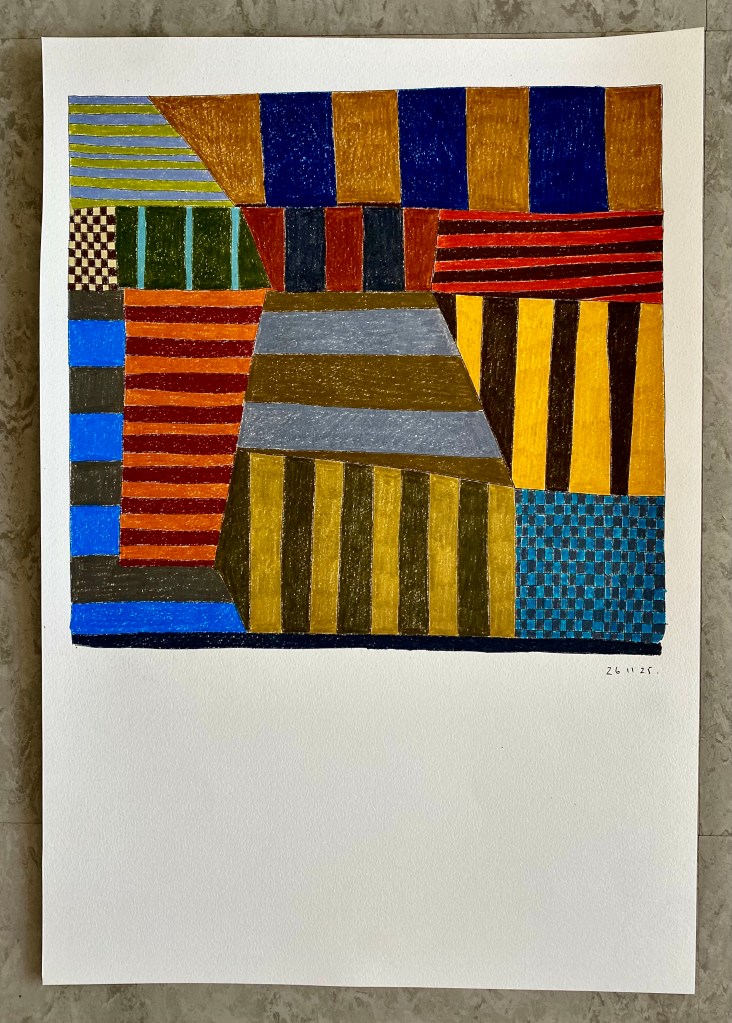
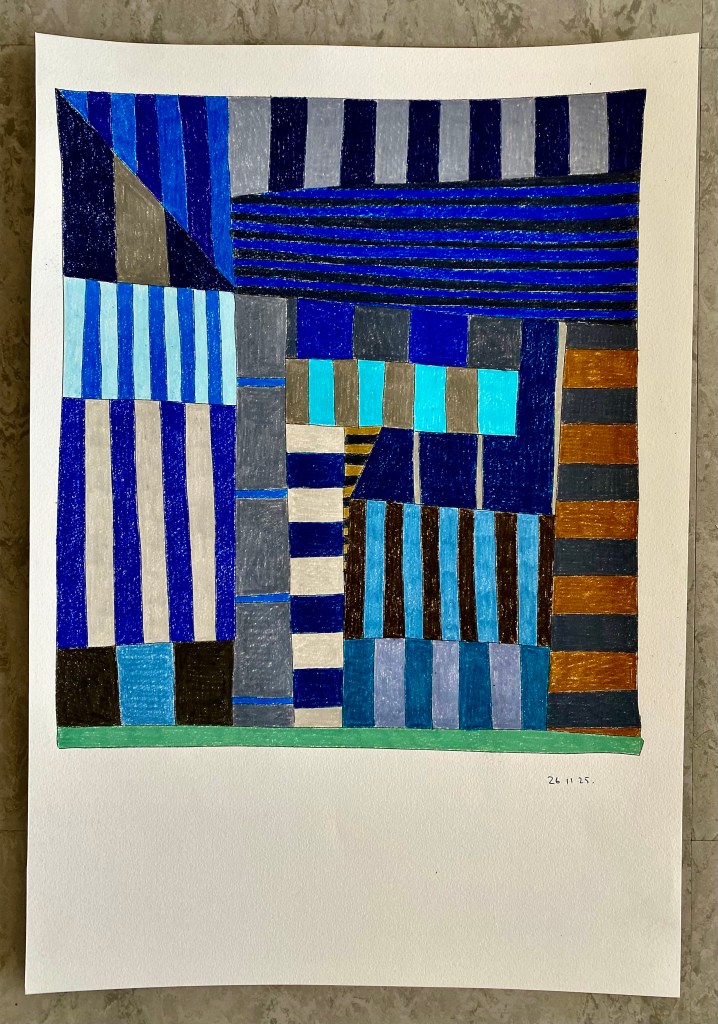
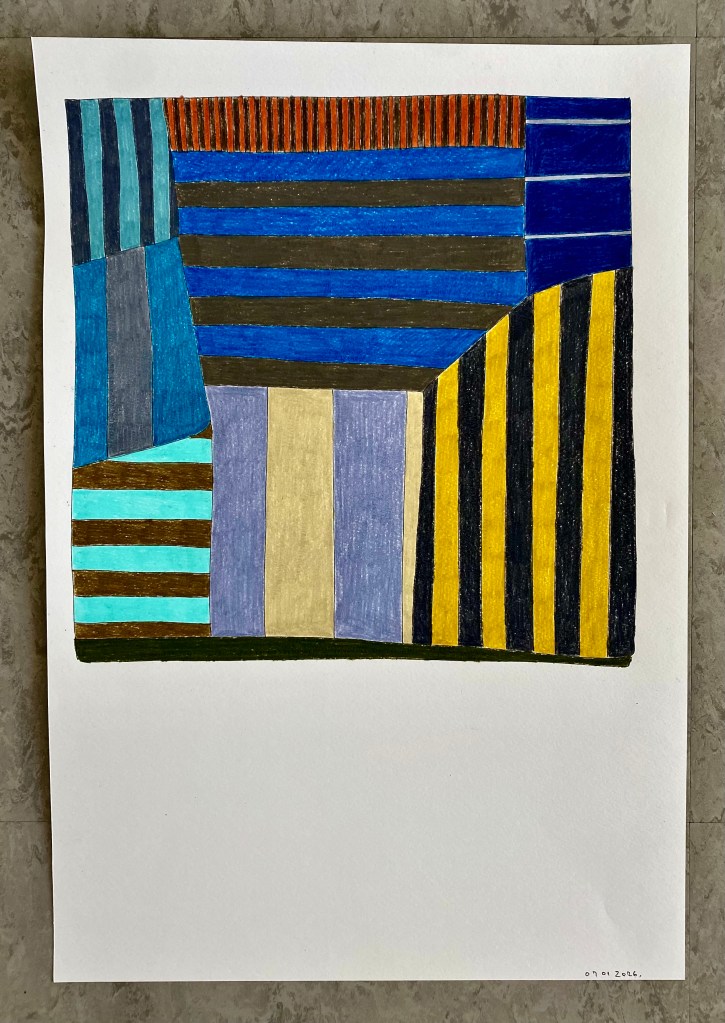
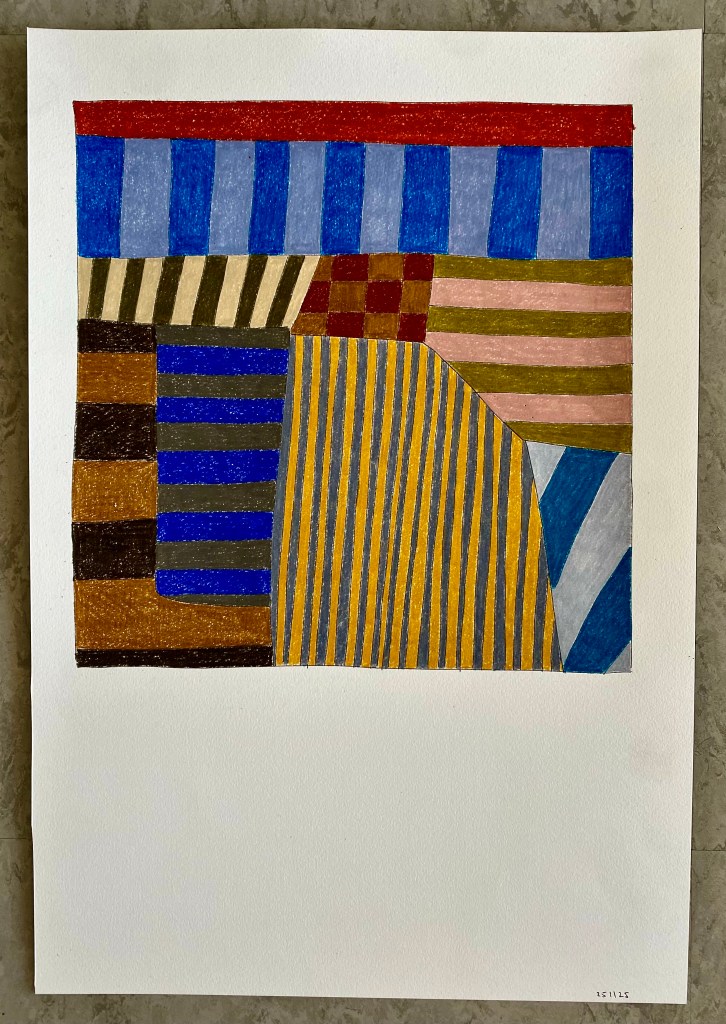
Repetitions 2026 are a series of drawings grounded in principles drawn from Ānāpāna meditation. Repetition, colour, and pattern are conditioned as perceptual systems that are brought into awareness rather than representation. As Alfred Korzybski asserts, “the territory is not the map”; these works do not attempt to depict experience, but instead construct systems that foreground the distinction between perception and what is perceived. Just as in Ānāpāna meditation the object is to repeatedly return to a single, neutral focus—the breath—the drawings operate through a comparable logic: repetition functions as a disciplined method of sustained attention, allowing difference and deviation to emerge within a controlled and stable framework.
Each work is developed through a consistent compositional structure of bands, grids, and segmented fields. This structure operates as a self-imposed constraint, analogous to the fixed point of attention in meditation. Within these limits, minor shifts in scale, direction, spacing, and colour become perceptually amplified. These changes are not expressive gestures but measured observations on attention. In this sense, the drawings resist what Walter Benjamin describes as the effects of mechanical reproduction, where repetition diminishes presence and singularity; here, repetition instead operates to intensify perceptual awareness, reconfiguring the notion of originality as something emergent through duration. As a result, the drawings function less as expressive images and more as temporal constructions, registering duration through accumulation and repetition.
Colour is treated as a material and phenomenological condition rather than a symbolic or emotive device. Saturated and muted tones are placed in direct relation, producing moments of compression, vibration, and visual pause. As in breath observation, sensation is attended to without emphasis or hierarchy. Through repetition, colour relationships are allowed to assert themselves gradually, encouraging a slow recalibration of perception rather than immediate impact. In this way, the work aligns with Marshall McLuhan’s proposition that “the medium is the message”: the meaning of the drawings does not reside in what they depict, but in how their structured repetition conditions the act of seeing itself.
Pattern, within this work, is not decorative but operational. It reflects the patterned nature of cognition itself: cycles of attention, distraction, and return without recourse to narrative or representation. Repetition becomes a means of observing these cycles rather than resolving them. Irregularities, asymmetries, and interruptions are retained as structural evidence of perception in flux and flow, reinforcing the instability between map and territory, image and experience.
Through sustained discipline, the drawings become a site of concentration. They propose repetition as a method of inquiry grounded in restraint, patience, and attentional endurance. Rather than illustrating meditative practice, Repetitions 2026 adopts its logic, using patterned systems to examine how states of being are structured, mediated, and continuously renegotiated through acts of attention over time.
 morgan veness